Best Music Distribution Platforms in India (2026 Comparison)
A practical comparison of the best music distribution platforms for Indian artists in 2026 — pricing models, royalty share, store coverage, caller tune support, payout speed, and India-specific features.
The "best" music distributor depends entirely on what you optimize for: lowest upfront cost, fastest payouts, deepest editorial relationships, broadest store coverage, or India-specific features like caller tune delivery and regional-language editorial pitching. This article compares the realistic options for Indian artists in 2026 and the criteria that actually matter.
The dimensions that actually matter
Most comparison articles list features. That is not useful — almost every distributor hits the same big DSPs. What separates them in practice:
- Royalty share model: 100% flat-fee vs revenue-share. At any meaningful catalog size, this is the single biggest economic factor.
- India-specific features: Caller tune (CRBT) delivery to Jio/Airtel/Vi/BSNL, regional language tagging quality, INR payout support with TDS handling, GST-compliant invoicing.
- Payout latency: How many days after DSPs report do you get paid? Monthly > quarterly.
- Splits and collaborator workflows: Multi-artist tracks need automated split payouts.
- YouTube Content ID: Whether they offer Content ID and how they handle dispute resolution.
- Catalogue migration: Whether you can move existing releases over without losing stream counts.
The flat-fee subscription tier
This is the dominant model for serious independent artists. You pay a fixed yearly fee per artist (or per release on some products) and keep 100% of master royalties.
SMSound India
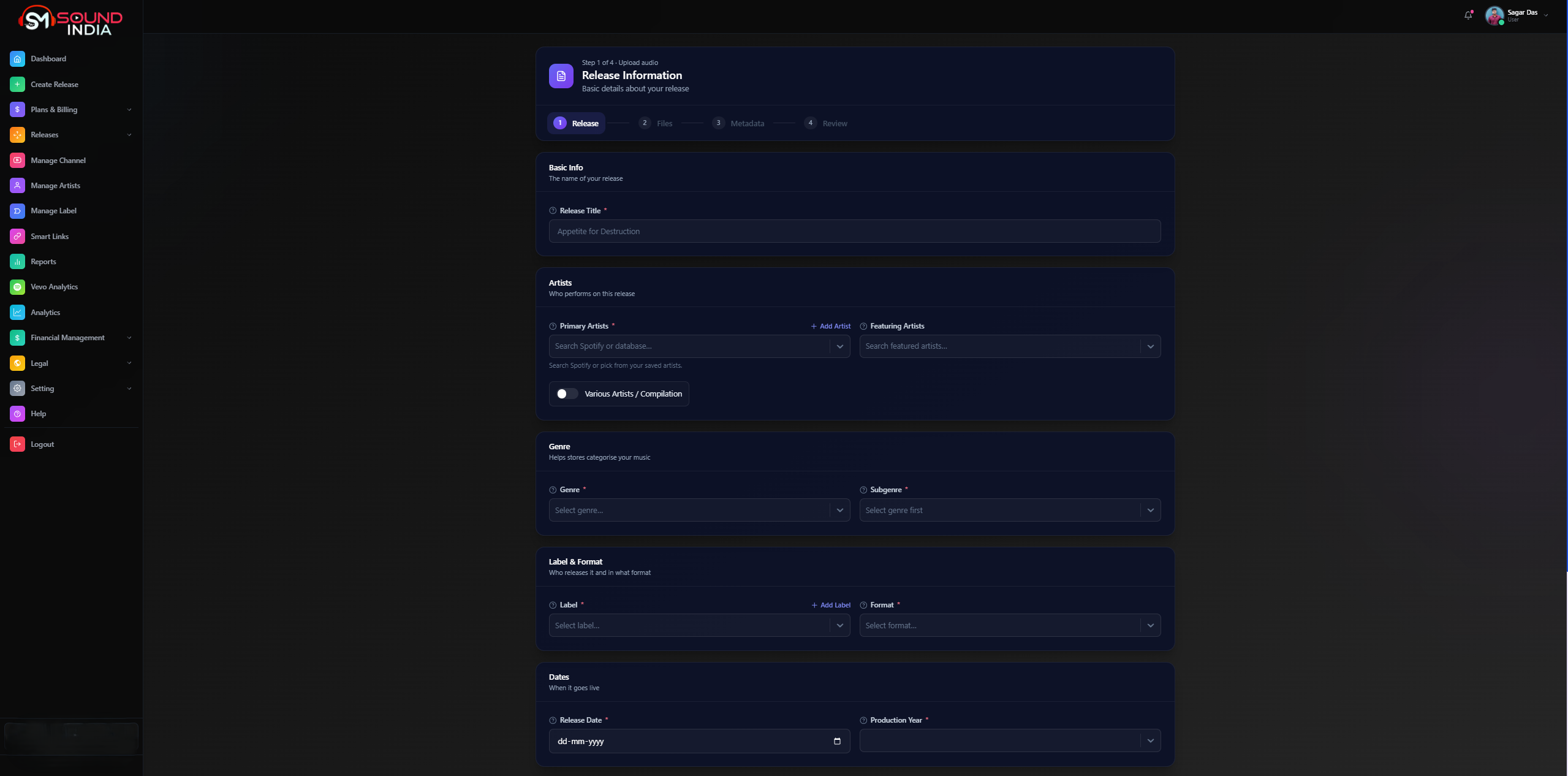
India-built, India-paid. Flat subscription with three tiers (Starter, Professional, Label). Full caller tune delivery to all four operators built in. INR payouts with TDS handled per current law. GST-compliant invoicing. Includes YouTube Content ID, OAC submission, and regional-language editorial tagging across JioSaavn and Gaana. Best fit if you release primarily for an Indian or India-diaspora audience.
DistroKid
Largest indie distributor globally by release volume. Flat per-year price, unlimited releases. Strong on Spotify integration and pre-save tooling. Weak on India-specific features — no caller tune delivery, payouts in USD with no built-in TDS handling, regional-language tagging is generic. Good if your audience is primarily Western.
TuneCore
Per-release pricing (or unlimited plan at a higher tier). Strong publishing administration add-on. Pays monthly. No native caller tune support. Decent for label-scale catalogues but the per-release model gets expensive for high-volume singles releases.
CD Baby
One-time fee per release plus 9% revenue share — actually a hybrid model. Bundled sync licensing and YouTube monetization. No caller tune. Good for artists who release infrequently and want low-friction setup.
RouteNote
Free tier with 15% revenue share, or premium tier with 100% royalties. UK-based. Weak on India-specific features. Reasonable if you are budget-constrained and have low expected revenue.
The revenue-share tier
Free upfront in exchange for an ongoing percentage cut. Useful for testing the waters; expensive once you start generating real revenue.
- Amuse Free: 0% cut on free tier (limited features), 100% royalties on paid tier. Strong mobile-first workflow.
- Spinnup Free: Limited release count, decent editorial relationships through parent (UMG).
- Ditto Music: Hybrid model. Marketing add-ons available.
India-specific decision tree
If you are choosing today, this is the rough decision tree:
- Primarily Indian audience + caller tune potential: SMSound India. The CRBT delivery alone often pays for the subscription.
- Primarily Western audience, English-language only: DistroKid or TuneCore. India-specific features are wasted.
- Small budget, just testing: RouteNote free or Amuse free, with a clear plan to migrate once revenue justifies it.
- Multi-artist label or 100+ track catalogue: SMSound India Label plan or TuneCore Label — both offer dedicated account management and split workflows.
The break-even math (flat-fee vs revenue-share)
Use this rough calculation: take the annual flat-fee, divide by your distributor's revenue share percentage on the rev-share alternative. The result is the annual royalty income at which the two models break even.
Example: a flat fee of $20/year on SMSound India Starter vs a 15% cut on RouteNote free. $20 ÷ 15% = $133. Once your annual royalty income crosses ~$133 (~₹11,000), the flat-fee plan is cheaper every year after.
At streaming rates of roughly ₹0.20 per Spotify Premium play, $133 in income is about 50,000 streams a year — which is a single mid-performing playlist add. Most artists cross the break-even within their first successful release.
What to ignore in marketing copy
- "150+ stores" — every serious distributor hits the same 150. Marginal stores 51–150 generate < 1% of revenue for most catalogs.
- "Editorial pitching" claims — the pitch form is the same Spotify-for-Artists form across all distributors. The distributor cannot influence editorial decisions.
- "Get on Spotify in 24 hours" — true for every distributor; not a differentiator.
- "Free pre-save links" — generated automatically by every modern distributor.
What to actually verify before signing up
- Can I get paid in INR to an Indian bank without USD conversion fees?
- Do they handle TDS and provide Form 16A quarterly?
- Is Content ID included or paid extra?
- Caller tune delivery to all four Indian operators — yes or no?
- What is the cancellation policy if I want to leave with my catalogue intact?
- Can I keep my existing ISRC codes when migrating?
Want a single answer? For most artists releasing primarily for an Indian audience in 2026, SMSound India is designed for this exact use case. Compare plans or read the full royalty mechanics guide before deciding.