How to Distribute Music in India (2026 Step-by-Step Guide)
A complete 2026 guide to distributing music in India — from picking a distributor to ISRC registration, DSP delivery, caller tune setup, royalty collection, and tax handling.
If you have a finished master sitting on your hard drive and you want it on Spotify, Apple Music, JioSaavn, Gaana, YouTube Music, and the rest of the world's streaming platforms — you need a distributor. Streaming services do not accept uploads directly from individual artists. They only ingest music delivered by approved digital distributors who agree to a strict format spec.
This guide walks through the full 2026 workflow for releasing music as an independent artist or small label in India: picking a distributor, prepping your files, registering codes, setting a release date, going live worldwide, and collecting royalties in INR.
Step 1: Pick the right kind of distributor
There are roughly three pricing models in the market right now. Each has trade-offs:
- Revenue-share (DistroKid Lite, Amuse Free, etc.): Free up front, but the distributor keeps 15–30% of every royalty payment forever. Best if you genuinely cannot afford a subscription and are not yet generating real revenue.
- Flat subscription (SMSound India, DistroKid, TuneCore): You pay a fixed yearly fee and keep 100% of your master royalties. Almost always more profitable once you cross ~5,000 streams a month. The crossover point comes faster than most artists think.
- Label deal: An actual label signs you, often takes 50%+ of master royalties, but provides marketing, advances, and editorial relationships. Only worth it if the label is bringing real promotional leverage.
For most independent artists releasing from India, the flat subscription model wins on long-horizon math. SMSound India sits in this category — flat fee, 100% of royalties, payouts in INR.
Step 2: Prep your audio, artwork, and metadata
Every DSP rejects releases with technical issues. Get these right before you upload:
- Audio: WAV file, 16-bit/44.1 kHz minimum (24-bit/48 kHz preferred). FLAC also accepted. No distortion, clipping, or excessive silence at the start. If you mixed in Atmos, also provide the ADM BWF.
- Cover art: 3000×3000 px square JPG or PNG. No URLs, social handles, distributor logos, or copyrighted imagery. Text on the cover must be the same as the title or artist name.
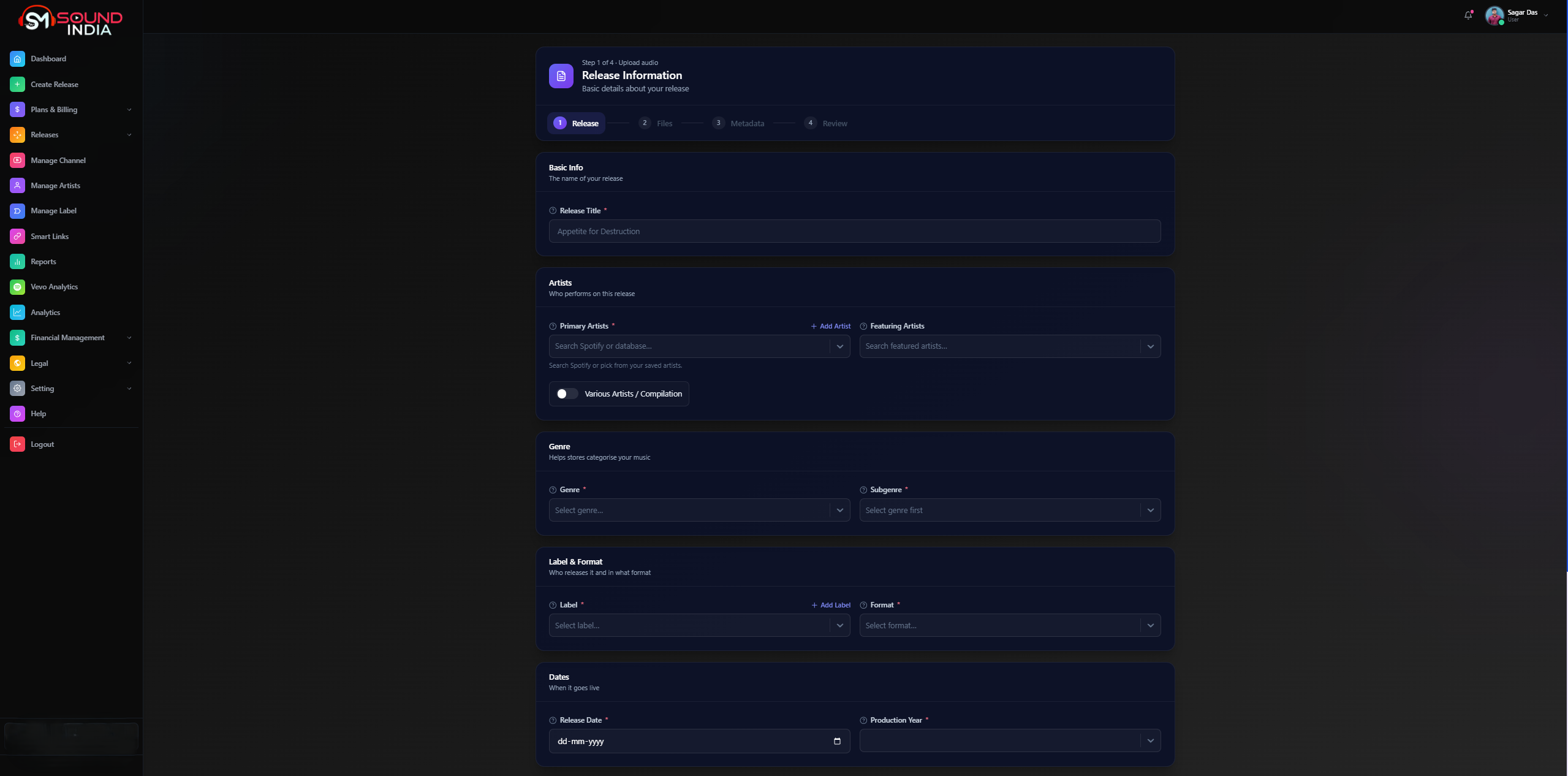
- Metadata: Artist name (spelled exactly as it should appear forever), track title, primary language, genre, sub-genre, contributors with roles (lyricist, composer, producer, mixer, master), explicit-content flag, lyrics or instrumental flag, and preview start time.
Step 3: Get your ISRC and UPC codes
Every recording needs a 12-character ISRC code, and every release needs a 12-digit UPC barcode. These are how stores, royalty societies, and YouTube Content ID identify your music across the entire global system.
A good distributor includes these for free. SMSound India issues globally-unique ISRCs and UPCs at no extra cost using the IFPI-allocated registrant prefix. If you are migrating an existing catalogue with codes already assigned, those are honoured so your stream counts and playlist placements stay intact across the move.
Step 4: Pick your stores and set a release date
For a release targeting Indian listeners, you want at minimum: Spotify, Apple Music, JioSaavn, Gaana, YouTube Music, Amazon Music, and Wynk. Add Boomplay if you want African reach, Anghami for the Middle East, and KKBOX/Joox for Southeast Asia. Beyond that, just turn on "all stores" — there is no cost difference and you might pick up unexpected streams from niche services.
For the release date: schedule at least 7 days ahead. This is the hard requirement to be eligible for Spotify editorial playlist pitching, and most other DSPs honour the same lead time. Two to three weeks of lead time is even better — it lets you build pre-saves, social momentum, and editorial reach.
Step 5: Pre-save campaign and release-day momentum
The first 24 hours of a release are disproportionately important to algorithmic playlists like Release Radar, Discover Weekly, and Daily Mix. Saves, completed plays (over 30 seconds), and shares in those first 24 hours tell Spotify's algorithm to push your track to more listeners in similar audience clusters.
A pre-save link converts an Instagram follower into a guaranteed first-day save. Most distributors (SMSound India included) generate these automatically once you set the release date. Post the link in your bio for the week before release, drop it in WhatsApp broadcasts, and pair it with short-form video on Reels and Shorts.
Step 6: Set up caller tunes (CRBT) for Indian operators
This is the step most global distribution guides skip — and it is one of the highest-leverage moves an Indian artist can make. Jio, Airtel, Vi, and BSNL each run a caller tune (CRBT) product where subscribers set songs as their pre-call ringback tone. Per-set royalties are paid every billing cycle the tune stays active.
For Hindi, Bhojpuri, Haryanvi, Punjabi, Tamil, Telugu, and devotional tracks, CRBT revenue can match or exceed streaming revenue. See our full caller tune distribution guide for the operator-by-operator breakdown.
Step 7: Verify your artist profiles
Once your first release is live, claim your Spotify for Artists, Apple Music for Artists, YouTube Official Artist Channel, and Amazon Music for Artists profiles. Verification unlocks blue checkmarks, artist images, bios, social links, and the editorial pitching tools.
Verified profiles also let you pitch upcoming releases directly to platform editorial teams — a free promotional channel that does not require an industry connection.
Step 8: Royalty collection, taxes, and society membership
DSPs report royalties 60–90 days after the consumption month. Your distributor collects the money, deducts applicable TDS (10% under Section 194J for Indian residents above the exemption threshold), and pays out monthly in INR to your bank, PayPal, or Payoneer.
Distribution only collects master recording royalties — there are five other royalty streams (mechanical, performance, neighbouring, sync, CRBT) handled by IPRS, PPL, ISRA, and the telecom operators. If you write your own songs, IPRS membership is non-negotiable. Read our full guide to music royalties in India for the complete breakdown.
What to expect in the first 30 days
- Day 0–7 (pre-release): Files delivered, editorial pitch filed, pre-save link in bio, release-week content scheduled.
- Day 8 (release day): Track goes live across all DSPs. Spotify for Artists profile shows real-time listener city map. First-24-hour saves measured.
- Day 9–14: Release Radar wave. Most algorithmic listeners surface here. Watch the save-rate, skip-rate, and completion-rate numbers.
- Day 15–30: Editorial placement decisions land. Discover Weekly adds happen. Reach plateaus unless promoted further.
- Day 60–120: First royalty statement arrives. Reality check on streaming income vs other streams.
The biggest mistakes to avoid
- Releasing on a Friday with no lead time — kills your editorial chance and pre-save funnel.
- Wrong language tag on JioSaavn / Gaana — kills your regional-language editorial chances.
- Skipping Content ID — leaving money on the table every time a fan uses your sound.
- Not joining IPRS as a songwriter — a single TV play can be worth thousands of streams.
- Using free-cut distributors past the break-even point — at scale you donate huge percentages of revenue.
Ready to release? Start with our step-by-step upload checklist or compare SMSound India distribution plans.