Music Copyright Guide for Indian Artists (Copyright Act 1957 + 2026 Practical Guide)
Everything Indian artists need to know about music copyright — the Copyright Act 1957, registering with the Copyright Office, ISRC/UPC, IPRS membership, sound recording vs composition rights, and dispute handling.
Copyright is the legal backbone of every royalty stream you collect as a musician. Streaming royalties exist because copyright law gives you the right to control reproduction. CRBT royalties exist for the same reason. Sync placements, Content ID claims, IPRS distributions — all of them flow from clean copyright ownership. This guide walks Indian artists through the practical mechanics.
What the Copyright Act 1957 actually says
Indian music copyright is governed by the Copyright Act, 1957 (substantially amended in 2012). It recognises two distinct copyright objects in any musical recording:
- The composition — the underlying lyrics + melody. Author: the lyricist (for lyrics) and composer (for melody).
- The sound recording — the specific captured performance. Author: the producer of the recording (or whoever paid for and supervised the session).
These are independently owned. You can compose a song and license someone else to record it. You can own a recording of a song you did not write. You can co-own either or both with collaborators.
Copyright is automatic — registration is optional but valuable
Copyright in India exists from the moment of creation. You do not need to register to have the right. That said, registration with the Copyright Office (Department for Promotion of Industry and Internal Trade, Government of India) creates a public record that is invaluable when you actually need to enforce.
Registration matters when:
- You are negotiating a sync deal — buyers want to see registered title.
- You are pursuing an infringement claim — a registered work has presumptive title in court.
- You are signing with a label or publisher — clean registration accelerates due diligence.
- You are joining IPRS as a publisher — registration is part of the application package.
How to register a song with the Indian Copyright Office
The application process for music is roughly:
- Form XIV filled in (separate forms for sound recording vs composition).
- Fee: ₹500 per work as of current notification (verify current rates with Copyright Office).
- Statement of Particulars + Statement of Further Particulars describing the work.
- Copies of the work: Lyrics in text + audio file for sound recordings.
- NOC from all contributors if multiple authors.
- Power of attorney if filed through a lawyer.
Processing typically takes 8–14 months from filing to certificate. The work is published in the Copyright Journal during the process, and objections can be raised within 30 days of publication.
ISRC and UPC — your global identifiers
ISRC (International Standard Recording Code) and UPC (Universal Product Code) are the two identifiers every release needs. They are how every DSP, royalty society, and YouTube Content ID system identifies your music across the global rights ecosystem.
- ISRC: 12-character code per individual recording. Format: CC-XXX-YY-NNNNN. The first two characters are the country code (IN for India), the next three are the registrant prefix, the next two are the year, and the last five are the unique sequence.
- UPC: 12-digit barcode per release product (single, EP, album).
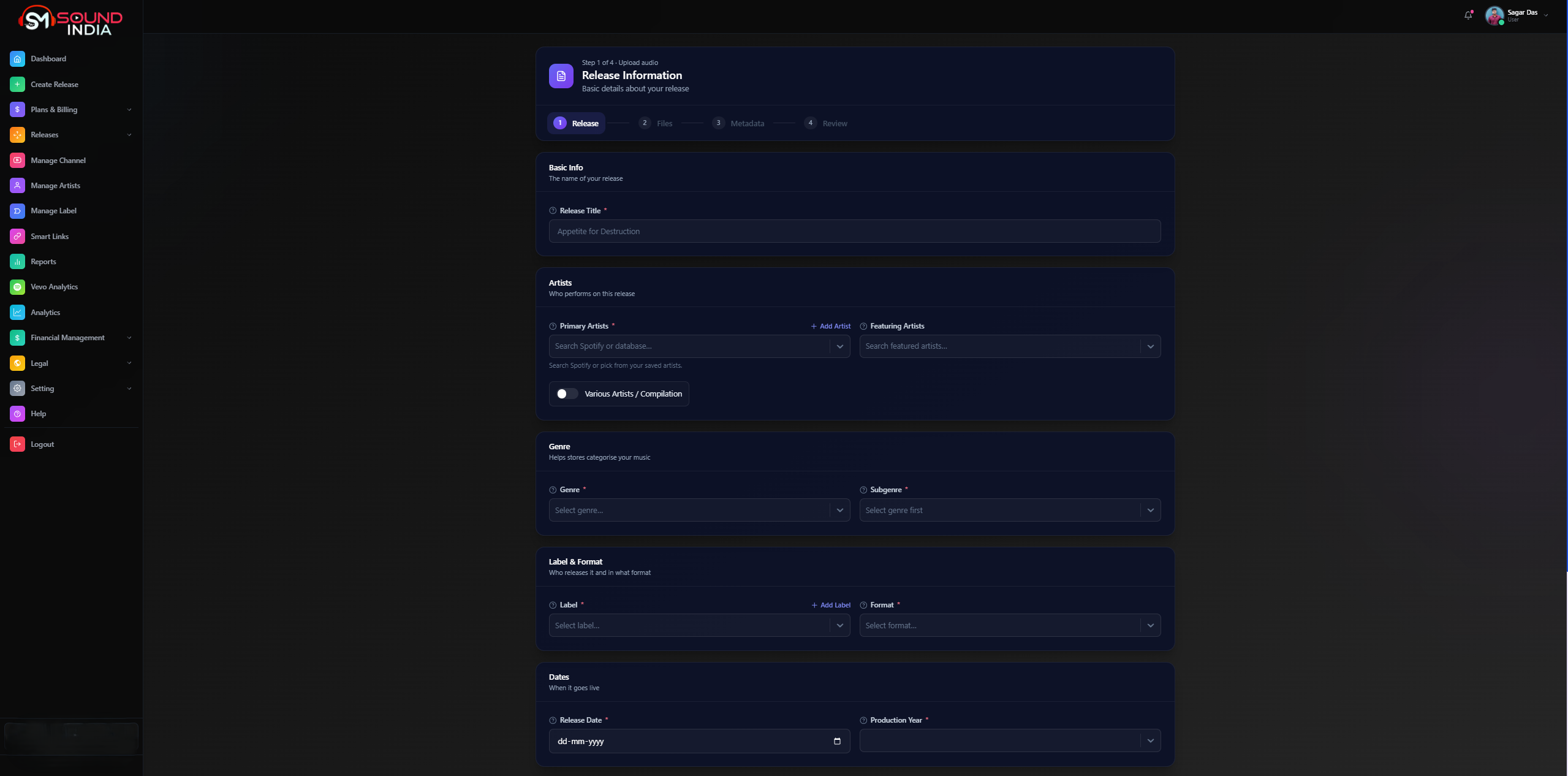
SMSound India issues both automatically with every release using the IFPI-allocated registrant prefix. If you are migrating an existing catalogue with codes already issued, those are honoured so your stream history stays intact.
IPRS, PPL, ISRA — picking the right societies
See our detailed music royalties guide for the full breakdown. The quick version: pick societies based on the role you actually play on the recording.
- You wrote lyrics or melody: Join IPRS as an author/composer. Collects performance and mechanical royalties.
- You sang or performed: Join ISRA as a performer. Collects the performer share of neighbouring rights.
- You own the master recording (paid for the session): Affiliate with PPL as a recording rightsholder. Collects the recording-owner share of neighbouring rights.
For a self-produced singer-songwriter who paid for their own session, all three may apply: IPRS (composer + publisher), ISRA (performer), PPL (recording owner). Each society distributes its own income separately.
Common copyright mistakes that cost real money
- No written split agreements with co-writers — leads to ugly disputes years later. Get a simple email-confirmed split percentage before the recording session if possible, definitely before release.
- Using uncleared samples — even short samples from existing recordings need clearance. Content ID will catch them, claims will redirect your revenue to the original rights holder, and you may face takedowns.
- Cover songs without composition license — releasing a cover requires a license for the underlying composition. SMSound India guides the cover-clearance workflow.
- Work-for-hire confusion — if you produced a track for someone else under work-for-hire, they own the master. Be clear in writing who owns what before money changes hands.
- Assuming public domain — many traditional songs are still under copyright by a publisher. Verify before releasing a "traditional" recording.
Handling infringement when it happens
When someone uses your music without authorization, your remedies depend on the platform:
- YouTube: Content ID handles 99% of cases automatically — your distributor files claims and collects revenue. See our Content ID explainer.
- Spotify, Apple Music, JioSaavn, Gaana: File a takedown through your distributor. Stores respond within 7–21 days for clear infringement cases.
- Instagram, Facebook, TikTok: Each platform has its own rights management portal. SMSound India can file on your behalf for clear infringement cases.
- Websites, ads, films: Cease-and-desist letter through an IP lawyer is the standard first step. Litigation is rare but available under Section 55 of the Copyright Act.
Copyright term — how long does it actually last?
- Compositions and lyrics: Lifetime of the author + 60 years. So a song written in 2026 by a 30-year-old who lives to 80 is in copyright until ~2136.
- Sound recordings: 60 years from year of publication. A recording released in 2026 enters the public domain in 2086.
- Performer's rights: 50 years from year of performance.
Need help registering, securing ISRC/UPC, or navigating the IPRS application? SMSound India copyright services covers the full workflow, from issue of identifiers to society affiliation guidance to dispute coordination with IP counsel.