Music Distribution for Independent Artists: The 2026 Playbook
A no-fluff playbook for independent artists in India — how to set up distribution, build pre-save momentum, get on playlists, monetize across platforms, and turn streams into a sustainable income.
Being an independent artist in 2026 is a completely different game than it was even five years ago. The distribution barrier is gone — anyone can be on Spotify, Apple Music, and YouTube next week. The new barrier is figuring out how to make that release matter. This playbook is what we wish every artist knew before their first SMSound India upload.
What "independent" actually means in 2026
Independent does not mean unsigned and broke. It means you own your master rights, control your release calendar, and choose your own promotional strategy. You can be independent and still work with a publishing admin, a sync agent, a PR firm, a producer with a points deal, and a distributor — none of those relationships sign away your masters.
The trade-off is real: independence means you are responsible for the business side. Distribution, royalty collection, copyright, sync outreach, social strategy, and accounting are all on you (or someone you hire). The upside is that 100% of master royalties stay with you forever.
The five-pillar release playbook
Pillar 1: Pick your distributor strategically
See our platform comparison. For most India-based independent artists, a flat-fee distributor like SMSound India wins on long-horizon economics. The crossover point comes faster than most artists expect — typically inside your first six months at any serious release cadence.
Pillar 2: Build a release calendar, not a release schedule
Release schedules are reactive ("when is the next song ready"). Release calendars are intentional (every release is positioned in the catalogue narrative). A typical independent artist calendar for 12 months might look like:
- 2 singles building toward an EP, spaced ~6 weeks apart.
- The EP release with 3–4 tracks (including the previously released singles).
- 2 follow-up singles in a related sonic direction.
- A cover or collab release to expand audience overlap.
- Year-end retrospective playlist or live EP.
This rhythm trains the algorithm. Spotify and Apple Music both reward consistent release cadence with better Release Radar and Discovery placement.
Pillar 3: Master the 14-day window around release
The 14-day window from T-7 to T+7 is where 80% of a release's long-term performance is decided.
- T-7 to T-3: Editorial pitch filed. Pre-save link in bio. Short-form video assets posted to Reels, Shorts, TikTok. Email/WhatsApp blast to existing fans.
- T-2 to T-1: Tease video clips with the audio. Cover-reveal post. Pre-save reminder in stories.
- T+0 (release day): Spotify for Artists profile live. Story post with the smart link. Replies to every comment in the first 6 hours.
- T+1 to T+7: Watch save rate > 25%, completion rate > 70%, skip rate < 25%. These are the algorithmic threshold metrics.
Pillar 4: Diversify your royalty streams
Streaming royalties alone are not a living for most independent artists. The artists who turn music into a sustainable income stack royalty streams:
- Streaming master royalties via distributor
- IPRS performance + mechanical royalties (if you write your songs)
- ISRA neighbouring rights (if you sing your recordings)
- YouTube Content ID for UGC monetization
- Caller tune (CRBT) revenue on Jio/Airtel/Vi/BSNL
- Sync placements (films, ads, TV, web series)
- Merch, ticketing, fan community subscriptions
Read our royalty mechanics deep-dive for the full breakdown.
Pillar 5: Build owned audience channels
DSPs are rented audiences — the algorithm controls who hears you. The artists with the most durable careers build owned channels you control: an email/WhatsApp list, a Discord, a Patreon-style subscription, a YouTube channel.
When the algorithm changes (and it will), owned channels are what survive. Aim to convert 1–3% of your monthly listeners into your owned audience over the first 12 months.
The realistic timeline for independent artists
- Month 1–3: First 1–3 releases. Spotify for Artists verified. Audience under 500 monthly listeners. Royalty income negligible.
- Month 4–9: Catalogue grows to 8–15 tracks. Editorial placements start landing. Monthly listeners reach 1K–5K. First small royalty payouts.
- Month 10–18: A breakout track or viral Shorts moment pushes you to 10K–50K monthly listeners. Caller tune revenue starts mattering for India-language artists. Sync inquiries begin.
- Year 2+: Established catalogue, recurring royalty income across multiple streams. Time spent on releases shifts from "every release matters infinitely" to "curating a catalogue."
The mistakes that kill most independent careers
- Treating each release as standalone — no narrative connecting them, no audience-building between drops.
- Buying playlist placements from sketchy promoters — gets you flagged for stream manipulation, can result in DSPs removing your catalogue entirely.
- Ignoring metadata — wrong language tag, wrong genre, missing songwriter credits. These errors cost real royalty income.
- Not joining IPRS as a songwriter — leaves performance/mechanical royalties unclaimed.
- Quitting after the first slow release — most catalogues compound over 18–36 months, not after a single song.
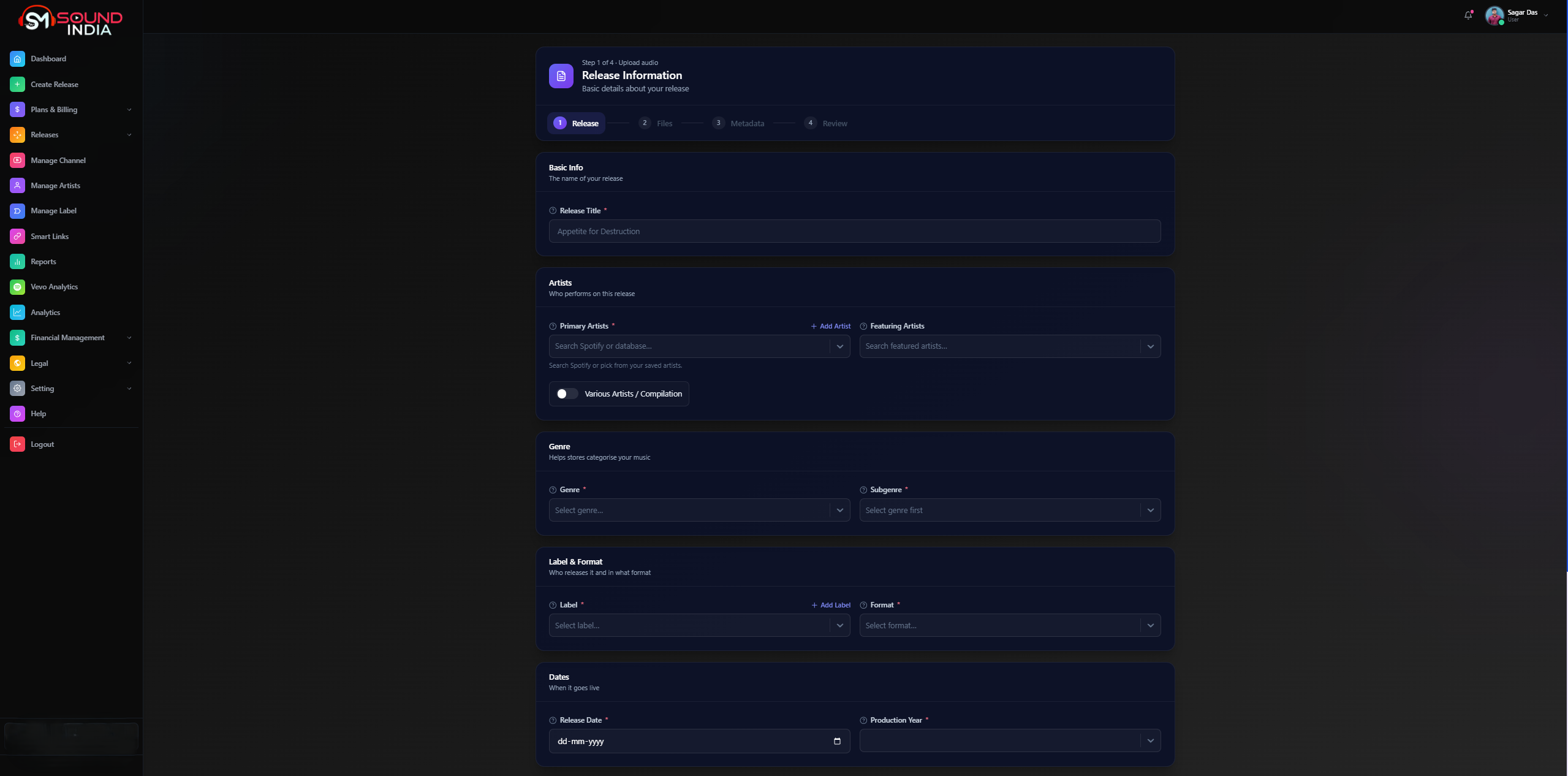
Ready to start? Begin with our step-by-step distribution guide and the SMSound India release checklist.